Tameside
Interfaith Network
Launch Conference
Held on 7
September 2004
Report
Introduction
The idea for an InterFaith Network for Tameside
has been evolving in different arenas across Tameside over the past year or so.
As part of T3SC’s role in supporting and developing the local Community
Empowerment Network (CEN) – Tameside Voice – our agency became involved with a
small group of individuals from different faiths in Tameside who were committed
to taking this work forward. From an initial meeting held in March 2004, a
Steering Group was formed with the aim of working towards a launch event in
September 2004. The funding for the event is from the Neighbourhood Renewal
Unit’s Community Participation Programme, and it is the intention that the
InterFaith Network will be part of Tameside Voice. The network has many
challenges and many opportunities to take up over the next years. Some of these
are strategic, and entail working at policy level; others are more related to
issues of common humanity, and will require a great deal of working at
grassroots level.
Tameside’s Community Cohesion Partnership is
supportive of this initiative, and recognises its potential benefits. However,
Tameside now appears to be the only District in Greater Manchester which does
not have faith representation at the Local Strategic Partnership, and this will
clearly be an immediate challenge for the network.
The success of the event speaks for itself in
the Report which follows. We are fortunate to have many talented, experienced
and committed individuals living and working amongst us. They will undoubtedly
ensure that this is just the start of the process of faith communities coming
together to learn and share, and -through joining forces – to be able to have a
real impact on issues relating to the quality of life for all residents in
Tameside.
Moira Cunningham
Chair of the Steering Group,
and Director – Tameside Third Sector Coalition
Foreword
The contribution of faith communities to civic
life has always been important, but it has now become an issue of some
political significance. In the light
of international events there is a much sharper public consciousness of
religion as a potential cause of division, and in
Within
this context there is a real need for faith communities to work together, to
counter the propaganda of those who would want to see religion divide
communities, and to make a positive contribution to regeneration programmes. It was therefore timely that Tameside
Third Sector Coalition was able to use Community Participation Programme
funding to bring together a wide range of faith groups and their partners to
set up an Interfaith Network.
It
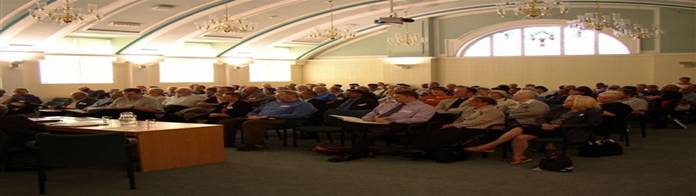
is encouraging that over 150 people participated in this inaugural conference,
and there was a positive and clear desire to work more closely together. Tameside is rich in religious and ethnic
communities, and the conference agreed that it was important for faith groups
to develop a much better understanding of each other, to build trust, and to
identify common areas of concern and activity.
In addition to the excellent speakers there were strong contributions in
and from the working groups, which will provide an agenda for the coming
months.
There
are real challenges to faith in our fragmented and often painful world. Working together faith communities can
make a real difference to regeneration programmes, community cohesion, and
public life. If the Interfaith Network
is to have real value then it needs to be much more than a meeting point and a
talking shop – useful as that will be in the early days. What matters, more than anything, will be
faith in action.
Gabrielle Cox
Conference Chair
Faith Groups
in Tameside
Martin Miller – Church of
England
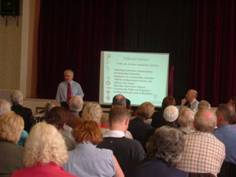
Martin Miller presented the facts and figures which tell the story of
Tameside and its communities.
Why are Faith
Groups involved in Partnership? (Greg
Smith,
- They are genuinely concerned for local
communities
- They may have valued which challenge
social exclusion
- They need funding support to survive
- They want to be good stewards of their
resources such as buildings
- They want to promote their reputation by
doing good
- Their own members are struggling
- They want to recruit new members
What do Faith
Groups bring to Partnership working?
- A value base provides extra motivation
- A long term presence in all areas
- A channel to hard to reach groups
- A source of volunteers
- A source of community facilities
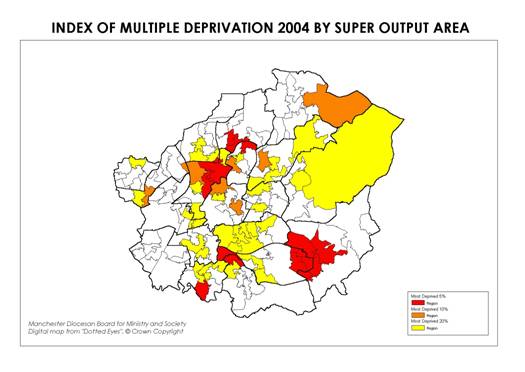
Introducing Super Output Areas
The
maps are based on the latest statistical geography: the Super Output Area
(SOA).
The
SOA used in the maps is the Lower Level SOA.
It is constructed from the smallest census “building block” or Output
Area. Between 4 to 6 Output Areas
combine to form an area with a population of approximately 1500.
Middle
and Upper Level SOAs are under development.
Since each layer of SOA will nestle within the one above, together they
form a complete system for collecting and presenting social and demographic
data.
|
|
Tameside |
|
|
No. Output Areas |
725 |
175,434 |
|
No. Lower Level SOAs |
141 |
32,482 |
What
are the advantages of this new statistical geography?
-
First, national coverage enables “like with like” comparison
across the whole of
-
Second, since SOAs are unaffected by regular boundary
reviews of electoral wards, it is possible to analyse change over time.
-
Third, as you will see from the maps, SOAs have immense
potential for promoting and supporting detailed analysis at neighbourhood
level.

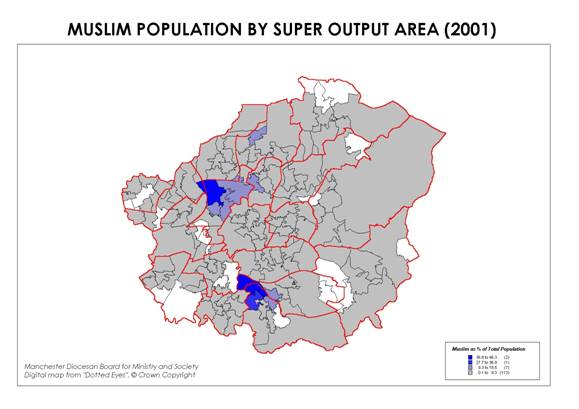
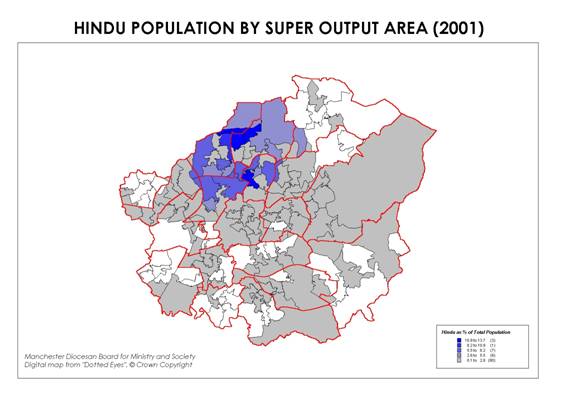


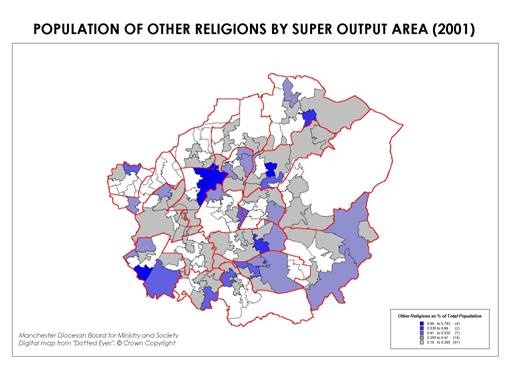
Greater
The figures are based on the
2001 Census.
It is important to note that
these figures give a perspective to the Faith Affiliation maps. For example, the colour gradient for the distribution of the Buddhist
community in Tameside relates to a total Buddhist population of 270.
|
Local Authority |
All people (number) |
% stating religion as: |
||||||||
|
|
|
Christian |
Buddhist |
Hindu |
Jewish |
Muslim |
Sikh |
Other Religions |
No Religion |
Religion not stated |
|
|
261037 |
74.56 |
0.1 |
2 |
0.06 |
7.07 |
0.03 |
0.15 |
8.75 |
7.28 |
|
Bury |
180608 |
73.68 |
0.14 |
0.37 |
4.94 |
3.74 |
0.11 |
0.17 |
10.16 |
6.7 |
|
|
392819 |
62.42 |
0.55 |
0.73 |
0.78 |
9.12 |
0.43 |
0.28 |
15.97 |
9.72 |
|
|
217273 |
72.62 |
0.11 |
0.61 |
0.04 |
11.06 |
0.03 |
0.12 |
8.92 |
6.47 |
|
|
205357 |
72.1 |
0.12 |
0.24 |
0.09 |
9.37 |
0.04 |
0.14 |
10.79 |
7.11 |
|
|
216103 |
76.46 |
0.22 |
0.32 |
2.4 |
1.2 |
0.11 |
0.15 |
11.01 |
8.12 |
|
|
284528 |
75.43 |
0.21 |
0.47 |
0.58 |
1.75 |
0.07 |
0.23 |
14.18 |
7.09 |
|
Tameside |
213043 |
75.54 |
0.13 |
1.36 |
0.04 |
2.52 |
0.03 |
0.17 |
12.1 |
8.11 |
|
Trafford |
210145 |
75.8 |
0.17 |
0.59 |
1.1 |
3.32 |
0.49 |
0.16 |
11.98 |
6.39 |
|
|
301415 |
86.85 |
0.09 |
0.17 |
0.03 |
0.33 |
0.02 |
0.09 |
6.88 |
5.55 |
|
Greater |
2482328 |
74.15 |
0.21 |
0.7 |
0.88 |
5.04 |
0.15 |
0.17 |
11.33 |
7.37 |
|
|
6729764 |
78.01 |
0.18 |
0.4 |
0.42 |
3.04 |
0.1 |
0.16 |
10.48 |
7.23 |
|
|
52041916 |
71.75 |
0.28 |
1.06 |
0.5 |
2.97 |
0.63 |
0.29 |
14.81 |
7.71 |
Data
from 2001 Census
Diocese of
Workshops
The feedback from all workshop sessions has been collated in the
following themed sections. Workshops in the morning focussed on examples of
faith communities already working together, and participants were encouraged to
draw lessons from this for Tameside. In the afternoon, workshops concentrated on
identifying a way forward for Tameside. Our aim was to engage commitment from
participants to taking this work forward in a practical way.
Barriers to joint working
v
Closed minds – people not listening to each other, and
being suspicious
v
Differing priorities
v
High expectations of ourselves which cannot be
achieved
v
Inhibitions about taking part due to fear and/or shyness
v
Language ( not least between those who share a
language)
v
Perceptions of differing social status - suspicion
v
Position of small minorities who can often be ignored,
and have less resources
v
Preconceived ideas
v
Pressure of time
v
Tensions
between secular organisations and faith groups
v
The costs of taking part
v
The different perspectives from grassroots and ‘authority’
Ideas to make the network
develop
Mapping
v
Find out who is out there
v
Profile the local community and ensure equitable representation
Engagement
v
Address internal Faith barriers (i.e. disagreements
within Faiths between different sects) in order to build consensus
representation
v
Attract religions not currently here to set up in
Tameside
v
Manage the gap between people at grassroots (giving
their time voluntarily) and workers (who can join in as part of their job)
v
Learn how to build (release) capacity in communities
Youth Involvement
v
Engaging youth especially disengaged young people
v
Work with upper juniors and university students – use
examples of practice
v
Engaging children through schools - both helpful and disconcerting
v
Address issues of women’s involvement across the board
Planning
v
Develop Aims and objectives
v
Secure funding
v
Identify what funding and resources can be offered by
partners
Infrastructure
v
Maximise existing structures
v
Complete Tameside structures – identify any gaps
v
Ensure network is informed about nature of support
available
Share Festivals
v
Partying – festivals
and more food!!
v
Plan and run a Festival – one month long – and include
history
v
Make faith festivals mainstream celebrations for
everyone
Learning
v
Learn from other people’s experience – other regions
v
Published booklet to include all our ideas and used in
schools
v
Video re. debt in Christianity and Islam
Networking
v
Liaison (other networks)
v
Joint working across areas
v
Enabling people to get to know each other through small
and local initiatives -> building up of effective network
Values into action
v
Action on ideas
v
Commitment –
patient slogging
v
Dialogue
v
Leadership
v
Task orientated
possibly focus on localised areas
Ideas on how a Network might
develop
v
Establish a steering group to produce an action plan
v
Draw up a list of individuals/groups prepared to sign
up to be practically involved
v
Identify and secure funding and resources
v
Maximise T3SC/Voice structures to ensure the network
has a strong voice at strategic policy level.
v
Recruit a full-time paid Interfaith co-ordinator
v
Draw in and upon existing experience and projects
already in progress
v
Come under the
umbrella of National Interfaith Council
What can you and/or your
organisation offer to help build a Tameside Interfaith Forum?
Provide speakers to raise
awareness
v
Zoroastrian and Buddhists
v
Speakers on Islam
v
Jewish Museum Manchester with extensive teaching
facilities
v
Ashton (
Provide links
v
Young people input (CEMVO): link with Global
Messengers (
v
Act as a forum for communication across community e.g.
women’s group
v
Provide representatives
v
Housing – tenants participation groups
v
Involve people who have
possible been excluded as have a lot. (PFT)
v
Parish nursing schemes – all faiths (dealing with
peoples needs)
v
Working with young people
In kind support
v
Space for meetings at a reasonable cost or free
v
Ashton regeneration – meeting rooms, staff time
v
TMBC input at officer level: Education
v
GMP – police officers to support any initiative of community
benefit
v
Organising skills for large events
v
Possible funding for staff via partners
Communication and promotion
v
New Charter Newsletters
v
Newsletters (diversity working lives group)
v
Attend next event - publicise
v
Willingness to enter discussion
v
Building of understanding and respect
v
Seminars
Networking
v
via PCT
v
Localise
v
Networking locally
v
Staff support groups- human resources
v
sub-regional areas for promotion
Strategic/ Structure support
v
Development of network
v
Build capacity of local people to maintain network
Undertake individual actions
v
Tackling racism etc via education and celebration –
Interfaith Harvest Festival
v
Proactive v retro
Demonstrate:
v
Patience
v
Commitment
What can we get out of this
initiative
v
Dialogue and understanding
v
Get closer to each other
v
Further dialogue between community leaders including
politicians and TMBC administration
v
Contacts
v
Contact point to make friends across the faiths
v
Meet with other faith groups – grass roots level
v
Education – meet more people
of other faiths (within our own groups)
v
Permanent displays in, say, libraries to inform.
/website
v
Recognition that we (Zoroastrians) exist
v
Community cohesion – All living together
v
Reduce racial hatred -> more people friends of
different religions
v
Break down barriers between faiths and focus on that
which we hold in common
v
Need to know more about each other -> better communication
v
Redevelop community through finding commonalities
v
Neighbourhoods working together and welcoming
v
Community benefit through coming together
v
Real work on
the ground as part of ongoing working day dialogue and practice
v
Tackling practical community issues together (drug abuse/litter)
v
GMP Structure – philosophy – information from communities to police and from police to communities to
give pointers as to what/where things are going wrong
v
TMBC is already involved in local good projects –
youth and culture
v
Quality public leadership
v
Working with young
people via groups (i.e. Guides) looking to work with other areas (beware of
issues)
v
Culture change
v
Change people’s attitudes (especially the young)
v
Engender the ‘feel’ within our communities
v
Friendship – removing ignorance
v
Permanent multifaith
centre
Priorities
v
Fellowship
v
Dialogue/networking
v
More joint parties/events
v
Youth engagement – priority + young people working
together
v
Communication across faiths including celebrations and
media strategy
v
Communication/education, strategic – personal
v
Involvement of women across the board
v
Purpose
v
Develop long term strategy
v
Project activity to be identified and implemented
v
Identify budgets for the longer term
v
Funding/ resources/time
v
Commitment
v
Integrity
v
Integration
Keynote
Speakers
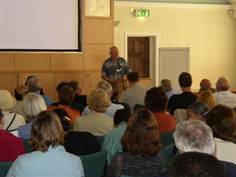 In the afternoon,
the Conference benefited from the wisdom and experience of two inspiring
speakers - Anjum Anwar – Education Officer, Lancashire Council of Mosques;
In the afternoon,
the Conference benefited from the wisdom and experience of two inspiring
speakers - Anjum Anwar – Education Officer, Lancashire Council of Mosques;
and Rev Dr Kenneth Leech – Priest, Writer and Lecturer.
These sessions focussed on the speakers’ own personal experiences, and
conference participants drew hope and encouragement from their messages, which
led us into an action planning session for Tameside.
Summary
The Conference has been an important milestone for the InterFaith
Steering Group; it has enabled us to take account of a wide variety of
perspectives, to learn about the vast range of resources that are available for
us – jointly – to draw on; and also enabled us to get a picture of the level of
commitment within Tameside to the idea of interfaith work. We have been surprised and delighted at the
number and variety of participants, which gives us confidence that this
initiative is timely, fills a gap, and has every possibility of succeeding in
breaking down some of the barriers to mutual understanding and joint working
for the benefit of Tameside communities.
A common vision is evolving, which might be articulated as:
“A network committed to
develop fellowship by increasing mutual understanding through dialogue,
networking, and engaging in joint action”
The Steering Group aims to formalise the structure which will enable
this work to develop, ensuring an inclusive process, and identifying resources
to facilitate this development.